
2026 Rental Property Tax Checklist + Essential Filing Tips
Your 2026 rental property tax checklist: deductions, deadlines, recordkeeping, and tips to maximize returns. Prepare now with confidence.
Rental property taxes aren’t just a once-a-year scramble. They’re a year-round strategy.
As we head into the 2026 tax season, landlords are facing tighter margins, shifting regulations, and increased IRS scrutiny on documentation. The difference between overpaying and optimizing often comes down to preparation.
This guide walks you through a practical 2026 rental property tax checklist, plus key insights from landlord trends—and a preview of what we’re seeing ahead of our upcoming 2026 Landlord Tax Survey Report.
Why 2026 Feels Different
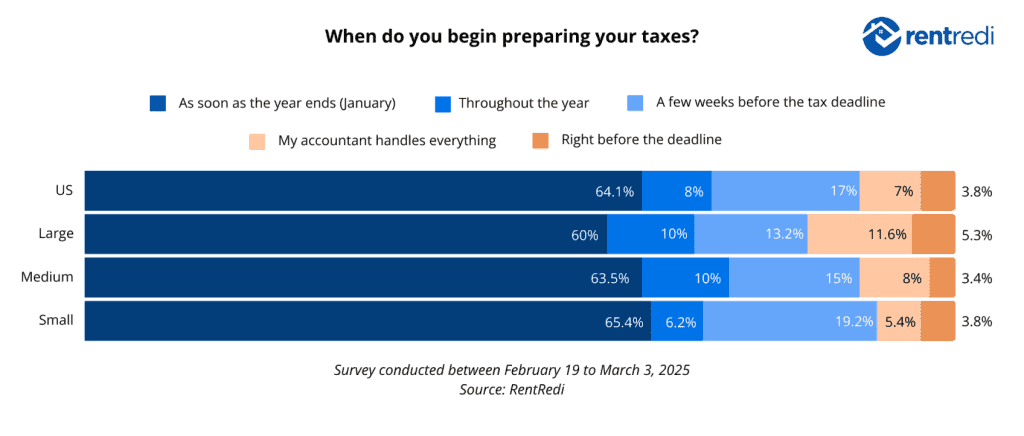
Rental tax strategy is becoming more data-driven. Based on patterns we’ve analyzed in prior years—including insights from our report on Tax Preparation Trends Among U.S. Landlords—we’re seeing:
More landlords filing without fully digitized records
Missed deductions due to inconsistent expense tracking
Growing reliance on software to centralize income and reporting
Increased audit anxiety tied to incomplete documentation
And 2026 is expected to amplify those trends.
2026 Rental Property Tax Checklist
Use this as your step-by-step framework.
1. Confirm Your Rental Income Records
Make sure you have:
Total rent collected (including late fees)
Security deposits (only if applied as income)
Prorated rent from move-ins/move-outs
Any other rental-related income
Tip: Cross-reference bank deposits against your rent ledger. Gaps are common when tenants pay across platforms or partially.
Platforms like RentRedi automatically track rent payments and generate income reports in real time, reducing reconciliation errors before tax season hits.
2. Categorize and Verify All Deductible Expenses
The most commonly missed deductions include:
Repairs vs. improvements (critical distinction)
Travel and mileage
Home office expenses
Property management software fees
Legal and professional services
Insurance premiums
Utilities paid on behalf of tenants
For deeper compliance guidance, review our full breakdown of Rental Property Recordkeeping Rules Every Landlord Should Follow. Additionally, review the complete IRS required proper documentation of rental income and expenses here: IRS Publication 527.
Important: Improvements must typically be depreciated, while repairs can usually be deducted immediately. Misclassification is a frequent audit trigger.
3. Review Depreciation Schedules
Depreciation is one of the most powerful wealth-building tools for landlords—but it’s often underutilized or calculated incorrectly.
Confirm:
Original purchase price allocation (land vs. structure)
Depreciation start date
Any capital improvements added in 2025
Correct recovery period (typically 27.5 years for residential rental)
If you’ve refinanced or converted a primary residence into a rental, your basis calculations may need review.
4. Reconcile Maintenance and Capital Expenses
Maintenance coordination is more than operational—it’s financial.
Every invoice should be:
Attached to a property
Categorized correctly
Stored digitally
Time-stamped
Without documentation, deductions may not survive scrutiny.
This is where centralized systems matter. When maintenance invoices, receipts, and vendor payments live in one place, your reporting becomes defensible—not just convenient.
5. Prepare Key Tax Forms
Most individual landlords will file:
Schedule E (Form 1040)
Form 4562 (Depreciation)
Possibly 1099-NEC for contractors paid $600+
If you paid contractors directly, confirm you’ve collected W-9 forms and issued 1099s where required. Schedule E is required when reporting rental property income.
6. Audit-Proof Your Recordkeeping
The IRS doesn’t require perfection—but it requires documentation.
Strong recordkeeping means:
Digital receipts (not shoeboxes)
Property-level expense tracking
Consistent monthly reconciliation
Clear separation between personal and rental finances
If your records feel fragmented, revisit our guide to Rental Property Recordkeeping Rules Every Landlord Should Follow.
7. Run Year-End Financial Reports
Before filing, generate:
Profit & Loss Statement (by property)
Cash flow summary
Expense breakdown by category
Tenant payment history
Having real-time access to these reports changes tax prep from reactive to strategic.
RentRedi’s Simple Accounting & Reporting tools allow landlords to instantly generate tax-ready reports—without exporting spreadsheets or stitching together multiple platforms.
Essential 2026 Tax Tips for Landlords
1. Don’t Wait Until March
The most costly mistakes happen in Q1 when landlords rush.
2. Track Monthly, Not Annually
Real-time categorization prevents missed deductions.
3. Separate Banking Immediately
If you haven’t already, isolate rental income and expenses.
4. Document Improvements the Day They Happen
Reconstructing months later leads to misclassification.
5. Use Software That Mirrors IRS Categories
The closer your reports align with Schedule E categories, the cleaner your filing.
The Bigger Picture: Taxes as a Wealth Strategy
Rental property taxes aren’t just compliance—they’re leverage.
Well-documented expenses reduce taxable income.
Proper depreciation builds long-term advantage.
Clean reporting strengthens lending applications.
The landlords who treat accounting as a strategic function—not an afterthought—tend to see stronger portfolio growth over time.
Make 2026 the Year You File with Confidence
If you’re still relying on manual spreadsheets, scattered receipts, or last-minute reconciliation, you’re working harder than necessary.
RentRedi centralizes:
Rent collection
Expense tracking
Maintenance invoices
Property-level reporting
Tax-ready financial statements
All in one place.
When tax season arrives, your records are already organized—because you’ve been operating that way all year.
👉 Start preparing for 2026 now.
👉 Generate schedule-E reports instantly.
👉 See exactly where your portfolio stands.
And keep an eye out for our full 2026 Landlord Tax Survey Report coming soon—we’ll share insights that can help you benchmark your strategy against landlords nationwide.
